Guides
New vs used wedding planning equipment, priced out
New vs used wedding planning equipment, decided by what a failure costs on a Saturday, with cost-per-wedding arithmetic and an item-by-item verdict.
What to take away
- New vs used wedding planning equipment turns on what an item's failure costs you at 4pm on a Saturday, when there is no second chance and no store open.
- Split the kit into two listsitems that fail loudly and stop the timeline, and items that fail quietly and cost you nothing but a trip to a store on Monday. Buy the first list new. Buy the second list however you like.
- The honest cost of any item is its price divided by the number of weddings it will survive, plus the cost of the one wedding where it does not.
- Used equipment is a good deal in this trade mainly through planners leaving the business, because their kit was assembled by someone who did the same job in the same venues.
- Typical U.S. prices as of 2026a new Motorola Talkabout T800 radio pair runs $100 to $130, a used pair $30 to $70; a new HP OfficeJet Pro 8025e printer runs $120 to $200, used $40 to $80.
The wrong question and the right one
New owners price equipment against a budget. That produces a kit assembled to hit a number, which is how a planner ends up with radios that cannot reach across a barn. The useful question is: if this item stops working during the wedding, what happens?
For most of what a coordinator carries, the answer is nothing much. A cart wheel that seizes on a Sunday strike is an annoyance. A sign stand that wobbles gets taped.
But a few items sit directly on the timeline, and their failure lands in front of two hundred guests. That difference, not the price tag, decides new or used.
The occupational description at U.S. Bureau of Labor Statistics: Meeting, Convention, and Event Planners frames the work as coordinating services and monitoring delivery under deadline pressure. Read that as a purchasing rule: the deadline is the thing you are protecting, and any item standing between you and it is bought new.
The arithmetic
Use named variables, but plug in real prices. The figures below are typical U.S. prices as of 2026, not quotes.
Cost per wedding formula
- (P + R) / Nfirst term
- Q x Dsecond term
- Q x Ddecides the answer
- P: the purchase price of the item, new or used.
- N: the number of weddings you expect it to survive. For used gear, N is what remains, not what it started with, and you are guessing.
- R: the cost of restocking or repairing it during its life, including the consumables it eats.
- Q: the probability, over its life, that it fails at a moment that matters.
- D: what one such failure costs. Not the replacement price: the refund, the apology, the review, the venue that stops referring you.
Cost per wedding is (P + R) divided by N, plus Q multiplied by D.
For a new $120 radio pair over 80 weddings, the first term is $1.50 per wedding. For a used $45 pair over 20 weddings, it is $2.25, before the failure term.
The first term is what people compare, but the second term decides the answer, and used gear loses there. A used radio set bought for a fraction of new might halve the first term and multiply the second. You cannot inspect a battery's remaining life, so you find out during the ceremony.
A new Motorola Talkabout T800 pair costs about $100 to $130. A used pair at $30 to $70 can halve the first term. It can also multiply the second: a mid-ceremony radio failure may cost a $1,500 refund credit and a lost venue referral worth $2,000.
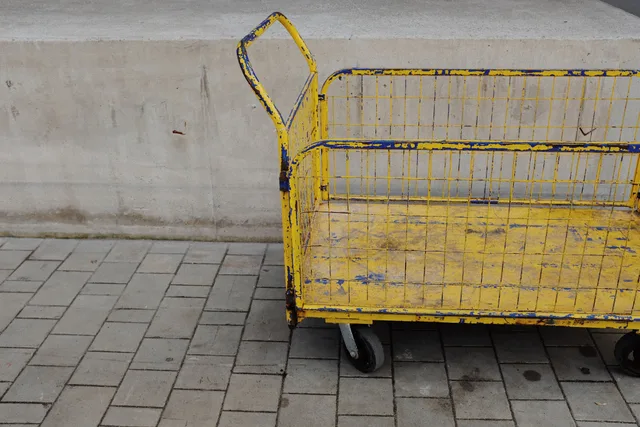
A used folding cart has a D of nearly nothing, so the first term is the whole calculation and used wins easily. A new Magna Cart Flatform runs about $60 to $100; a used one $25 to $50.
You cannot measure Q or D precisely. You do not need to. You only need to sort your kit into items with a high D and items without one, which takes ten minutes with the list in the equipment and setup overview.
Item by item
The table below uses typical U.S. prices as of 2026. Treat them as ranges, because brand, condition and season move them.
| Item | Buy | Typical new price | Typical used price | The reasoning |
|---|---|---|---|---|
| Two-way radios and earpieces, such as Motorola Talkabout T800 or Midland LXT600 | New | $100-$130 per pair, plus $10-$20 earpieces | $30-$70 per pair | High D, and battery condition is invisible on inspection. This is the one line where a used bargain is a false economy |
| Printer for timelines and signage, such as HP OfficeJet Pro 8025e or Canon PIXMA TR8620 | Used is fine | $120-$200 | $40-$80 | Fails on a weekday, in your office, where a copy shop exists |
| Folding cart, such as Magna Cart Flatform or Harper Trucks convertible hand truck | Used is fine, if the wheels are sound | $60-$150 | $25-$80 | Inspectable, repairable, and a failure costs a second trip |
| Emergency bag contents, including sealed first aid and medication | New, always | $40-$120 for a stocked kit | $10-$30, but avoid | Sealed consumables. Nobody should be handed opened medication or old adhesive |
| Steamer and small tools, such as Rowenta DR8080 or Jiffy J-2000 | Either | $60-$300 | $20-$150 | Test under load before the first wedding rather than trusting the listing |
| Vehicle | Either, on its own merits | $30,000 and up for a new compact van | $15,000-$25,000 for a used Ford Transit Connect | This is a vehicle purchase, not an equipment purchase. Judge it on reliability and load space |
| Design and decor inventory, such as arches, vases and candle holders | Used, deliberately | $100-$300 per arch, $1-$5 per vase | $50-$200 per arch, $0.50-$3 per vase | The largest saving available, and condition is fully visible. Storage and cleaning are the real costs |
| Laptop and phone | New or refurbished with a warranty | $800-$1,200 laptop, $400-$900 phone | $300-$700 laptop, $200-$500 phone | Contracts, timelines and the couple's documents live here |
The pattern is plain once it is written down. Everything that carries a cue, a document or a person's safety gets bought new. Everything that carries an object gets bought used.
The price gap is real but not decisive. Radios save $30 to $70 used; decor saves 30% to 50%. The failure cost still decides.
New or used by item
Item
- Two-way radios
- New
- Printer
- Used
- Folding cart
- Used
- Emergency bag
- New
- Steamer and tools
- Either
- Design and decor
- Used
Buy
- Two-way radios
- High D, battery invisible
- Printer
- Fails on weekday
- Folding cart
- Inspectable, repairable
- Emergency bag
- Sealed consumables
- Steamer and tools
- Test under load
- Design and decor
- Condition fully visible
Reasoning
- Two-way radios
- Printer
- Folding cart
- Emergency bag
- Steamer and tools
- Design and decor
Where buying used actually pays
The best used purchase in this trade is not a marketplace listing. It is a planner's kit from a closing business. It was assembled for the venues you work and sorted into bags that make sense.
The seller can tell you which barn defeats which radio. Ask venue contacts when they hear of someone leaving. That conversation beats the discount.
Rental company clearances are the second source, mostly for decor and signage. Estate and event-hall clearances are the third. In all three cases you are buying the seller's knowledge alongside the objects, which is why a slightly worse price from a planner beats a better one from a stranger.
Rental clearances often price arches at $50 to $150 and signage at $5 to $25 per piece. A planner's closing sale may bundle carts, clipboards and bags for $200 to $600.
Before you hand over money for used gear
Before you hand over money
- Power everything on, on the spot, and run it for longer than a demonstration takes. Radios go on for twenty minutes, at range, with the earpieces in.
- Ask what it was used for and how often. A cart from a working planner has done a hundred load-ins; a cart from a garage has done four.
- Inspect the parts that carry weight or heatwheels, hinges, straps, cables, plugs.
- Price the consumables it needs before it is usable, and add them to P. For radios, a replacement battery pack often costs $15 to $30; for a steamer, descaling supplies $10 to $20.
- Decide where it fails. If you cannot say what happens when it stops, you have not finished the check.
Safety is part of this check, not separate from it, and setup and strike are where injuries happen in this business. Secondhand ladders, straps and extension cords are exactly the items that fail under load.
Used gear inspection checklist
- Power on and run longer than demo
- Ask what it was used for
- Inspect wheels, hinges, straps, cables
- Price consumables and add to P
- Decide where it fails
Occupational Safety and Health Administration: Safety Management sets out the habit of finding and fixing hazards before an incident does. Applied to a used purchase, the frayed cord is not a discount but a reason to walk away.
What this changes about the rest of the business
Two things follow. First, the kit checklist for a first season, set out in the equipment checklist for new owners, should be read with the new-or-used column filled in before any of it is bought. The order you buy in matters more than the total.
A first-season kit built around the table above typically runs $1,200 to $2,500 new. Used carts, decor and printer can bring that to $500 to $1,200, but keep radios and emergency supplies new.
Second, a second lead planner or a second assistant needs their own kit, and that is when the used market becomes useful. The day-of team's carts, clipboards and setup bags can all be secondhand. What cannot be secondhand is the radio set, because now two teams are on it.
A second radio set adds $100 to $130 new, or $30 to $70 used, and this is the line where used can cost more later.
How a second team is built and trained is the subject of the hiring and training overview, and the people side of it, finding assistants who show up, is covered in how reliable day-of staff are found. Whether you need a second team at all is a capacity question answered in what happens once the Saturdays are sold.
One caution. If you buy used decor and advertise an in-house collection, your website photographs must be your own inventory in the condition a couple would receive it. Federal Trade Commission: Advertising FAQs: A Guide for Small Business requires advertising claims to be truthful and supported.
A stock photograph of an arch you do not own is a claim you cannot support.
Common questions
Is there anything I should never buy used?
Radios, sealed emergency-bag consumables, and anything that will hold weight above a guest's head. The first two because condition is invisible, the third because the failure is not a business problem.
Should I buy the whole kit at once?
No. Buy the communications, paper and emergency bags before the first wedding and let the rest accumulate. Every planner's list of setup items is shaped by what their venues do not provide, and you cannot know that until you have worked in them.
How do I know when N has run out?
You will not, which is the argument for replacing high-D items on a schedule rather than on failure. Pick a number of seasons, write it in the equipment record, and replace on that date even when the item still works.