Guides
Wedding coordinator equipment: four bags, a cart, and what to buy first
A working guide to the four bags and cart a wedding coordinator carries, the venue setup sequence, safety during setup, and what to buy first.
What to take away
- A coordinator's equipment has one jobto absorb the fifteen minutes that go missing on every wedding day before they become an hour. Judge every purchase by that standard and most of the catalog disappears.
- The kit is four bags and a cart, plus the vehicle that carries them. Everything else is either the venue's, a vendor's, or design inventory, which is a separate business decision.
- The venue's load-in window and curfew decide the setup plan, not the other way round. Walk the route from the parking spot to the ceremony site with the cart before the wedding week.
- Radios, printed timelines and the emergency bag are the three items that get used at every wedding. Buy those first and buy them well.
What equipment is for in this trade
Planners do not own the tables, linens, or lighting; the venue or a rental company does. A coordinator carries the items that keep a timeline intact when something slips.
A radio moves an assistant without leaving the ceremony, and a printed timeline goes to the late-arriving vendor. A sewing kit fixes a bridesmaid whose strap has gone, and a cart moves 100 place cards from a car parked farther away than the venue promised.
That framing keeps spending honest. If an item would not have saved time or prevented a visible failure at a wedding you have run, it waits.
The federal job description is a useful check: U.S. Bureau of Labor Statistics: Meeting, Convention, and Event Planners describes coordinating services and monitoring delivery, not producing them. Your kit supports coordination. Production equipment belongs to the vendors who produce.
The four bags
The communications bag. Two-way radios for every member of the day-of team, with earpieces so that a cue does not broadcast across a quiet ceremony, spare batteries or a charging block, and a laminated channel plan. Radios matter because a phone requires the other person to look at it; a radio requires them to hear it. Test the range across the largest venue you work at, because a barn with a stone wall between ceremony and reception can defeat a cheap set.
The paper bag. The full day-of timeline, printed, in more copies than there are vendors, plus a one-page version for the couple's parents and wedding party. Vendor contact sheet. Floor plan with table numbers. Seating chart. Ceremony order. Contracts for every vendor, because the caterer's arrival time argument is settled by the contract, not by memory. A clipboard for each assistant. Pens that work in rain.
The emergency bag. Built by someone who has needed the contents: sewing kit and safety pins, fashion tape, stain remover, a lint roller, blister care, pain relievers in sealed packaging, tissues, a small first aid kit, bug spray and sunscreen for outdoor sites, a steamer, scissors, tape of three kinds, zip ties, a lighter for candles the venue permits, cash for a vendor gratuity envelope that went missing, phone chargers with every connector. Restock it after every wedding, on the Sunday, before you forget what was used.
The setup bag. What you need to place the couple's personal items: a box cutter, extra easels, sign stands, string, a small tool kit, spare vases and floral wire for the centerpiece that arrived damaged, a tablecloth for the gift table nobody thought about, a small extension cord and gaffer tape for the DJ's cable that crosses a walkway.
Which bag absorbs which failure
| What slips on the day | The bag that absorbs it | What it costs you without that bag |
|---|---|---|
| An assistant is needed somewhere else, now | Communications | You leave the aisle to find them, and the ceremony starts late |
| A vendor arrives claiming a different time | Paper, holding their contract | An argument settled by memory, which you lose |
| A strap goes, a hem drops, a guest is unwell | Emergency | A wedding party member missing from photographs |
| A centerpiece arrives damaged, a sign has no stand | Setup | A visible gap where something was promised |
| The car is parked further away than promised | The cart | Ten minutes each way, repeated |
The cart and the vehicle
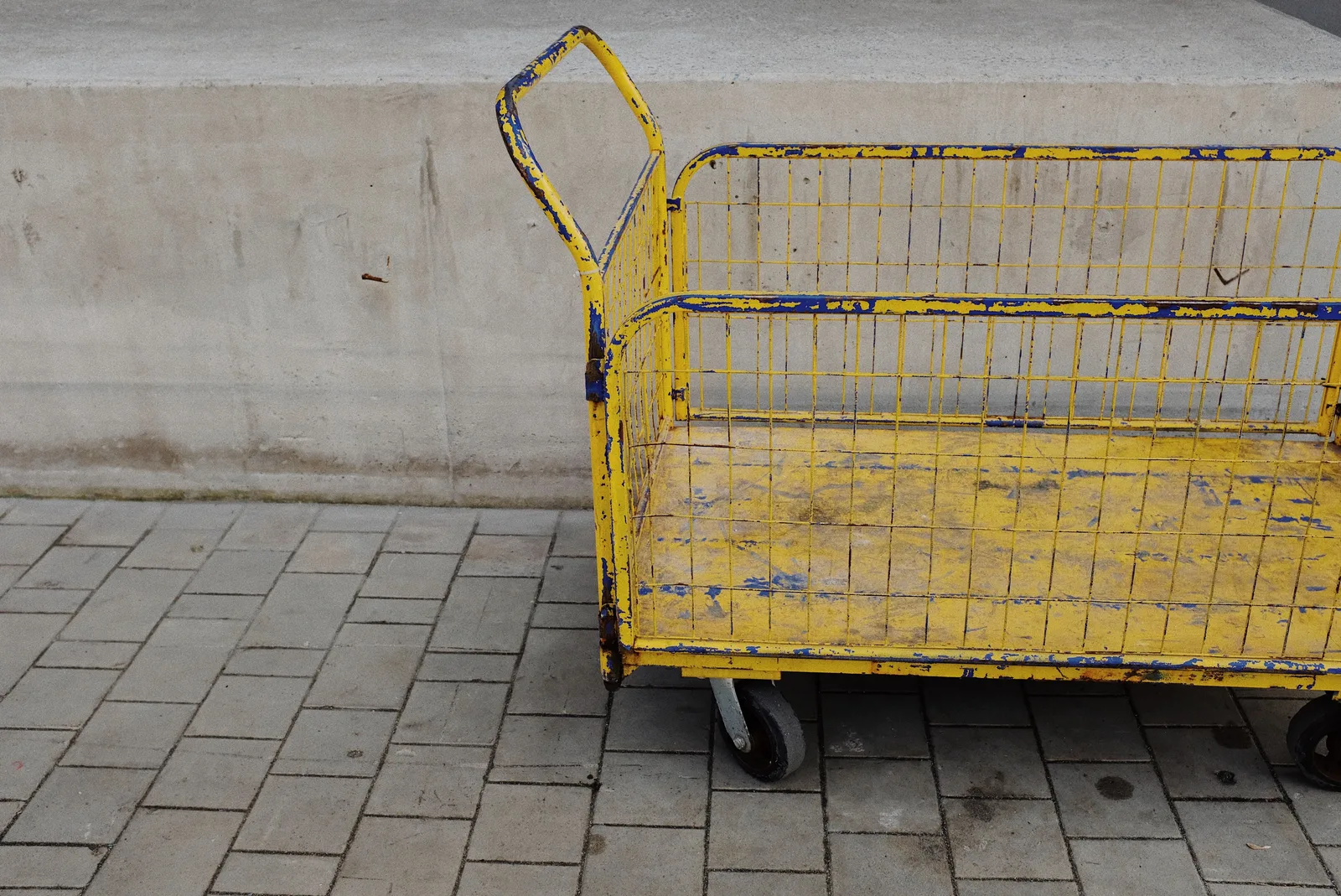
A folding cart with pneumatic or large solid wheels, because the route from the car to the venue's back door is gravel more often than it is concrete. Test it loaded, on a slope, with one hand, because the other hand will be holding a radio.
The vehicle must hold four bags, the cart, and a rolling rack for welcome bags or signage. It also needs room for the assistant and the item the couple hands you at the rehearsal.
It must also park where the venue allows during the wedding, which is a contract question. Some venues move vendor vehicles to a distant lot at guest arrival, so the cart trip becomes ten minutes each way.
Setup inside the load-in window
The venue contract gives you a load-in time and a curfew. Between them the setup plan is fixed. The order below assumes a single coordinator and one assistant and a load-in of a few hours; a longer window changes the pace, not the sequence.
- Arrive at the load-in time, not before, because early arrival at a venue with a morning event can put you in the way and cost goodwill.
- Walk the venue once, empty, against the floor plan. Confirm the ceremony site, the cocktail area, the reception layout and where each vendor will load. Note anything that differs from the walkthrough.
- Meet each vendor at their arrival time with their copy of the timeline and their load-in point. Rentals first, then catering, then florals, then music and lighting, then photography and the officiant, in the order their contracts say.
- Place the couple's personal items last, once tables are set, so that place cards are not moved by the linens crew.
- Do a final walk at the time the timeline says guests arrive, with the radio on, and hand the assistant the ceremony cue sheet.
Strike runs the same order in reverse, against the curfew. Ask the venue whether the curfew means music off, guests out or vendors out, because the difference is an hour of labor.
Safety in setup and strike
Setup and strike are where people get hurt in this trade: lifting, ladders for signage, cables across walkways, candles, and a strike done in the dark by tired people. The federal approach to small-business safety, Occupational Safety and Health Administration: Safety Management, is to find and fix hazards before an injury or an inspection does.
For a planner, a short list walked at each venue: where are the cables, who is on the ladder, is anything carried on stairs alone, and what does the venue require for open flame.
Whether specific requirements apply to you as an employer is a question for the agency and your state. The habit of looking for hazards applies regardless.
Office equipment, briefly
The office is a laptop, a phone with a good camera for walkthrough photos, a printer that handles card stock for timelines and signs, and a scanner or scanning app for contracts. Secure storage holds the couple's documents. A second monitor makes floor plans easier.
None of this is specialized. The specialized part is discipline: contracts scanned the day they are signed, timelines versioned so the vendor copy and the couple copy never drift apart.
Equipment purchases are business records. Internal Revenue Service: What kind of records should I keep? covers keeping documents that support purchases and assets. Keep the receipt for the radios with the receipt for the cart, and ask your accountant how equipment should be recorded rather than assuming.
Design inventory is a separate decision
Some planners own decor: candle holders, signage frames, table numbers, arches. This is production equipment, and it changes the business. It needs storage, cleaning, transport, an inventory system and insurance, and it puts you in competition with rental companies who are also your referral partners. Decide it deliberately, after a season, and never because a couple asked once.
If you do advertise an inventory, describe it as it is. Federal Trade Commission: Advertising FAQs: A Guide for Small Business requires advertising claims to be truthful and supported. "Extensive in-house decor collection" is a claim about what you own, and the photograph beside it should be your inventory at your wedding.
How the kit connects to the rest of the business
Which packages you sell decides which bags grow. A coordination-only business needs the four bags and the cart. Partial and full planning add the design bag and, often, the decision about inventory; that decision is made on the package ladder in the services and packages overview.
The market decides the vehicle. A planner whose venues are barns at the end of gravel roads needs a different car from one whose venues are downtown hotels with loading docks. That is one more reason the venue table in the startup and market orientation comes before any purchase.
Common questions
Do I need the radios if I have one assistant?
Yes. The moment you need to move the assistant is the moment you are standing at the top of the aisle and cannot look at a phone. A single pair of radios is the best-value purchase on this page.
How much of this can I borrow from vendors?
Very little, and you should not try. A caterer's cart is doing catering. Your kit exists so that you never have to ask.
Should I buy the kit before my first paid wedding?
Buy the communications bag, the paper bag and the emergency bag before the first wedding, and the cart if the first venue's parking is more than a short walk from its door. Buy the setup bag once you have seen what the couples in your market hand you at the rehearsal.